
A simplified version of this guide is available in the article Getting Started – DNS.
This article covers the detailed setup of a domain’s DNS records. If you only need to point DNS to VEDOS services, read the article Domains – Pointing DNS to Services.
If you need to change the domain’s DNS servers (NSSET), follow the guide Domains – DNS servers (NSSET). For more information about the difference between DNS records and DNS servers, see the article DNS – Manual.
In this article you will learn:
- When to use this guide
- How domain DNS records work
- What basic record types exist
- How to list and read a domain’s DNS records
- How to add, delete or edit a domain’s DNS records
- Common issues
- Frequently asked questions
When to use this guide
Use this guide, for example, in these situations:
- The provider of your e-shop, email or another service has sent you DNS records to enter (domain verification, SPF, DKIM, TXT). You will find the procedure in the chapter Managing DNS records, values from the service guide in the chapter A record from another service does not work.
- The service’s guide asks for a record named @. The solution is in the chapter Can’t enter a record named @.
- The administration reports “Cannot insert a CNAME record with this name” or another error. See Errors when creating or editing DNS records.
- You entered the record, but nothing changed after an hour. See Record changes do not take effect.
- The old website is displayed after moving the website. See The old website is still displayed.
- Emails stopped arriving after the DNS change. See Emails stopped arriving.
DNS records
DNS records point a domain and its subdomains (including www) to websites, email and other services on the Internet. To run DNS correctly, you need:
- A second-level domain (e.g. wds-test.cz) for which you will set up DNS.
- DNS Servers, which store the DNS records. They are usually provided by the domain registrar, the hosting provider or another service.
- DNS record names, types and data, which you get from the provider of the service you want to point the domain or subdomain to.
Basic DNS record types
Here is an overview of the most commonly used DNS records with links to their detailed descriptions.
- A Records are used to specify the IPv4 address of the server that runs your website. For more information, see the article DNS – A and AAAA Records.
- AAAA Records are used to specify the IPv6 address of the server with your website (if it uses one). For more information, see the article DNS – A and AAAA Records.
- ALIAS records can replace A and AAAA records for the main domain. For more information, see the article DNS – ALIAS and CNAME Records.
- CNAME Records are used for so-called domain aliases. For more information, see the article DNS – ALIAS and CNAME Records.
- MX Records are used to specify the names of the MX mail servers that receive your email. For more information, see the article DNS – MX Record.
- TXT Records are used to pass various domain settings, for example SPF and DMARC.
We also support these record types: NS, DNAME, SRV, NAPTR, CAA, HTTPS, SSHFP, TLSA, SVCB, PTR and DS.
For more details on how DNS works, see the article DNS – Manual.
Listing a domain’s DNS records
To view the overview of DNS records, follow these steps:
- Log in to Customer Administration ⧉.
- In the top menu, select DNS.
- Open the details of the domain.
- In the left menu, click DNS records.
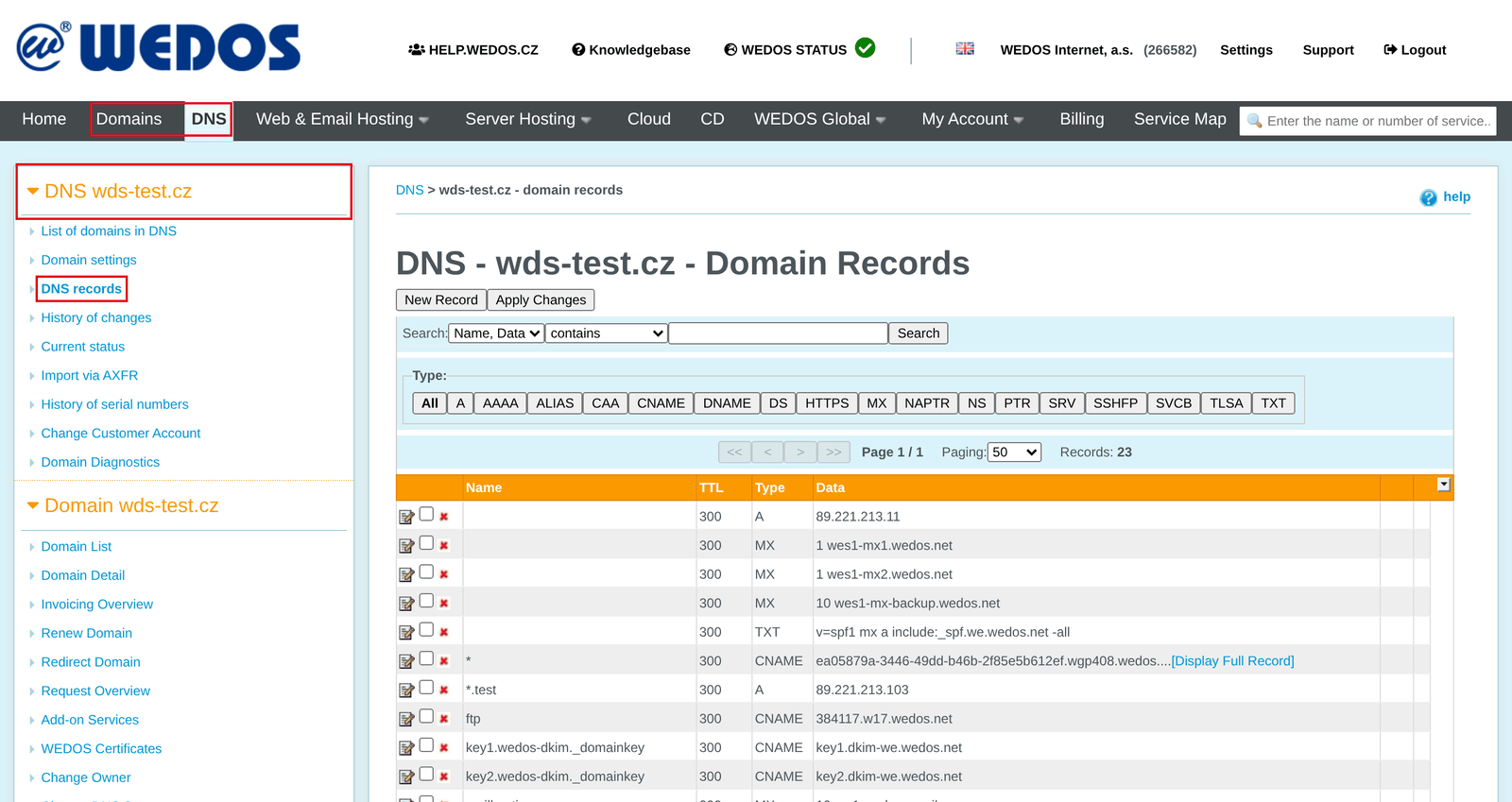
The table shows the list of the domain’s DNS records. Each record contains:
- Name relative to the current domain (do not include the domain name itself). An empty name means the record applies directly to the domain; otherwise it is the name of a subdomain. The * character in the name matches all other subdomains that are not listed in DNS explicitly.
- TTL, i.e. the time after which the record is updated. It is usually set to 1800 s (30 minutes) or 300 s (5 minutes). The allowed range is 300 to 172 800 s (5 minutes to 2 days). TTL values of records with the same name and type must be identical.
- Type, which determines the purpose of the record. For more information, see the section Basic record types and their use.
- Data, the actual instructions for how the domain behaves.

Managing DNS records
Changes to DNS records usually take effect within 60 minutes.
Before changing DNS records, make sure you know the current provider of the domain’s DNS servers.
Changes to DNS records at VEDOS will not take effect while the domain uses another provider’s DNS servers.
With listed DNS records using the controls directly in the overview. Records can be added, edited, or deleted.
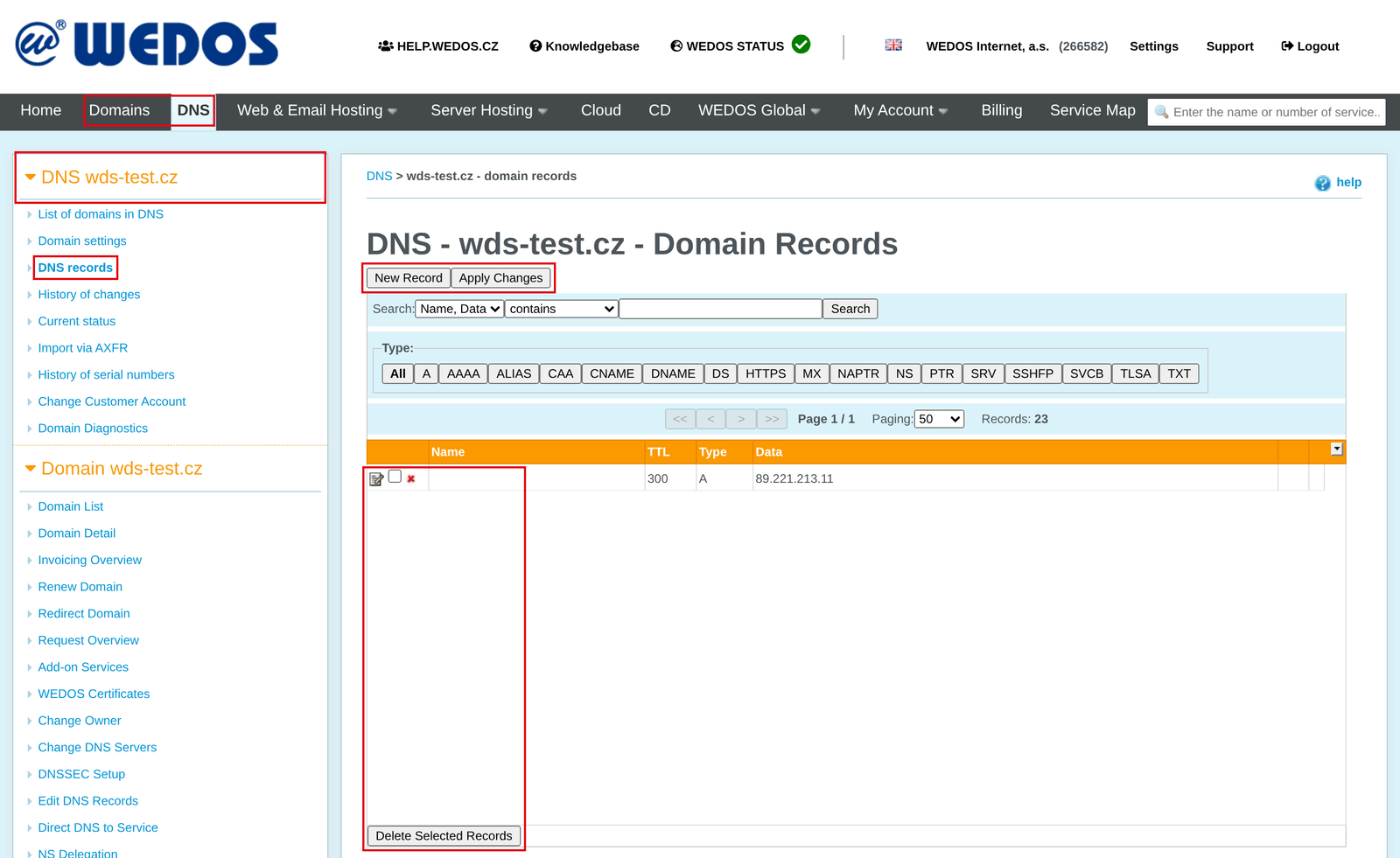
Adding a record
To add a new record to the list, follow these steps:
- Click New Record button above the list of DNS records.
- In the record details, fill in the name, TTL, type and data. If the record applies to the main domain, leave the Name field empty.
- Click Save Record.
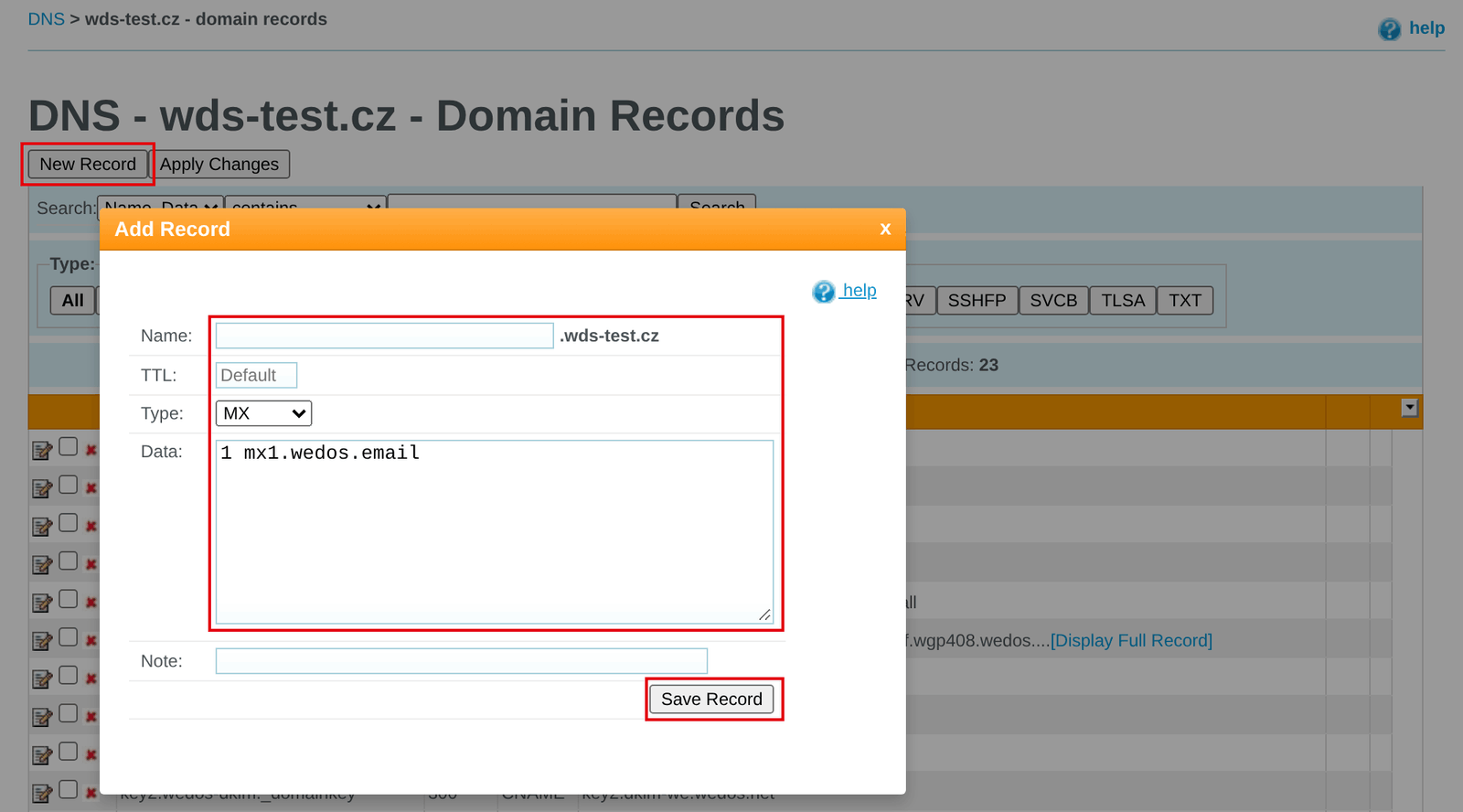
When creating a new record, follow these rules:
- For a record for the main domain (e.g. wds-test.cz), leave the name empty.
- For all subdomains not specified elsewhere, enter this character as the name: *.
- To cover all subdomains of a given subdomain, enter an asterisk before its name, e.g. *.cdn for obrazek.cdn.wds-test.cz. The asterisk may only appear at the very left as a separate part of the name; it cannot be entered anywhere else in the name. NS records with an asterisk in the name are not supported.
- For a specific subdomain, enter only its name without the name of the domain you are setting DNS for (e.g. for shop.wds-test.cz, enter only shop). Records with the character * in the name then do not apply to this subdomain.
- Enter the TTL in the range 300 to 172 800 s (5 minutes to 2 days). The system does not accept a record with any other value; in that case WAPI returns an error with code 2317.
- Enter a long TXT record value (over 255 characters) into the data field in one piece. The system will split it into parts.
Editing a record
To change the TTL or data of a record, follow these steps:
- Click the pencil icon on the left side of the corresponding table row.
- Enter the required changes in the record details.
- Click Edit Record.
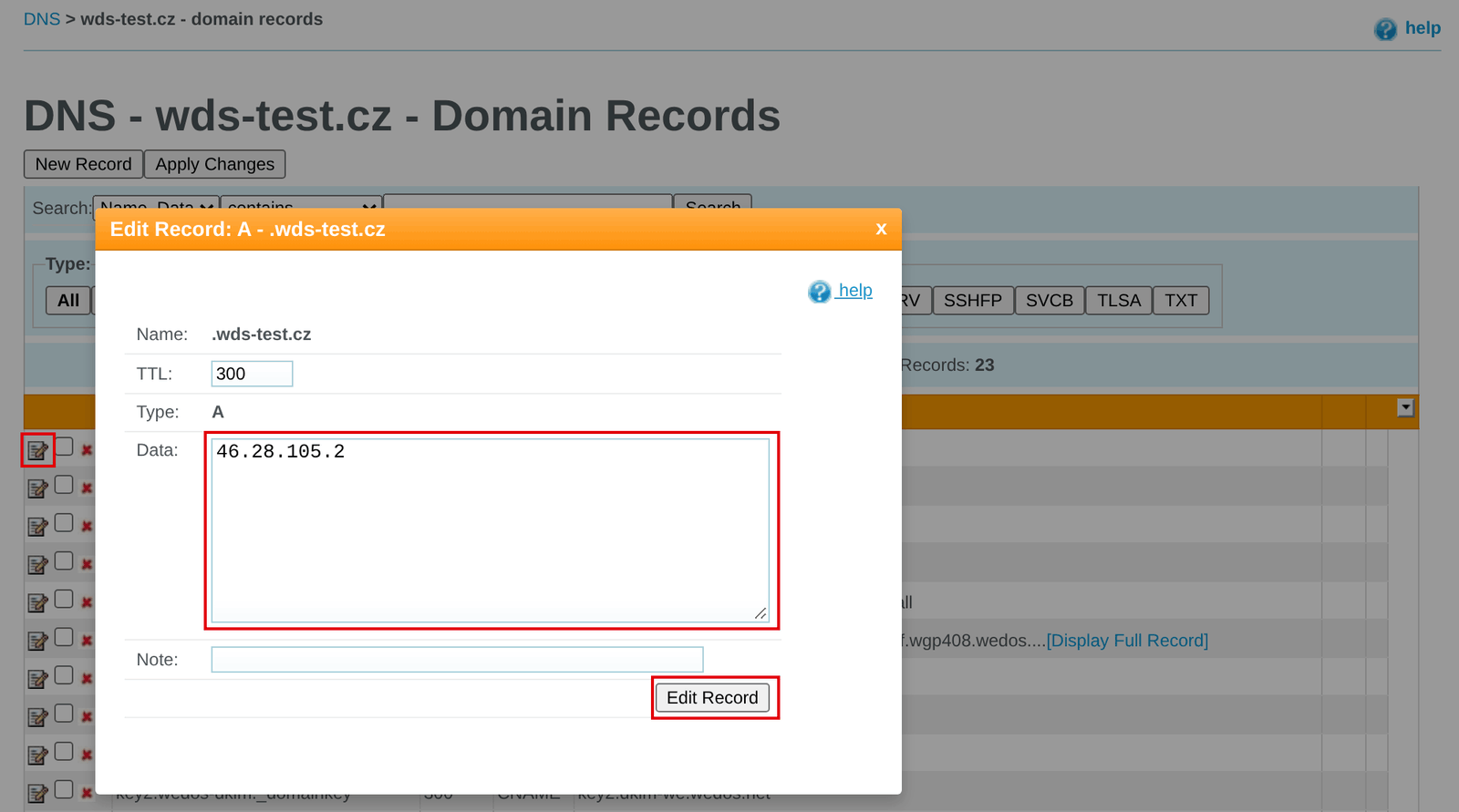
If you need to change the name or type of a record, delete and add a new one with the correct details.
When you have finished editing, click Apply Changes. This confirms your changes and prepares them for processing. If you do not confirm the changes with the button, the system applies them automatically after 5 minutes.
Deleting a record
To delete a record you no longer need, click the red cross button on the left side of the record list.
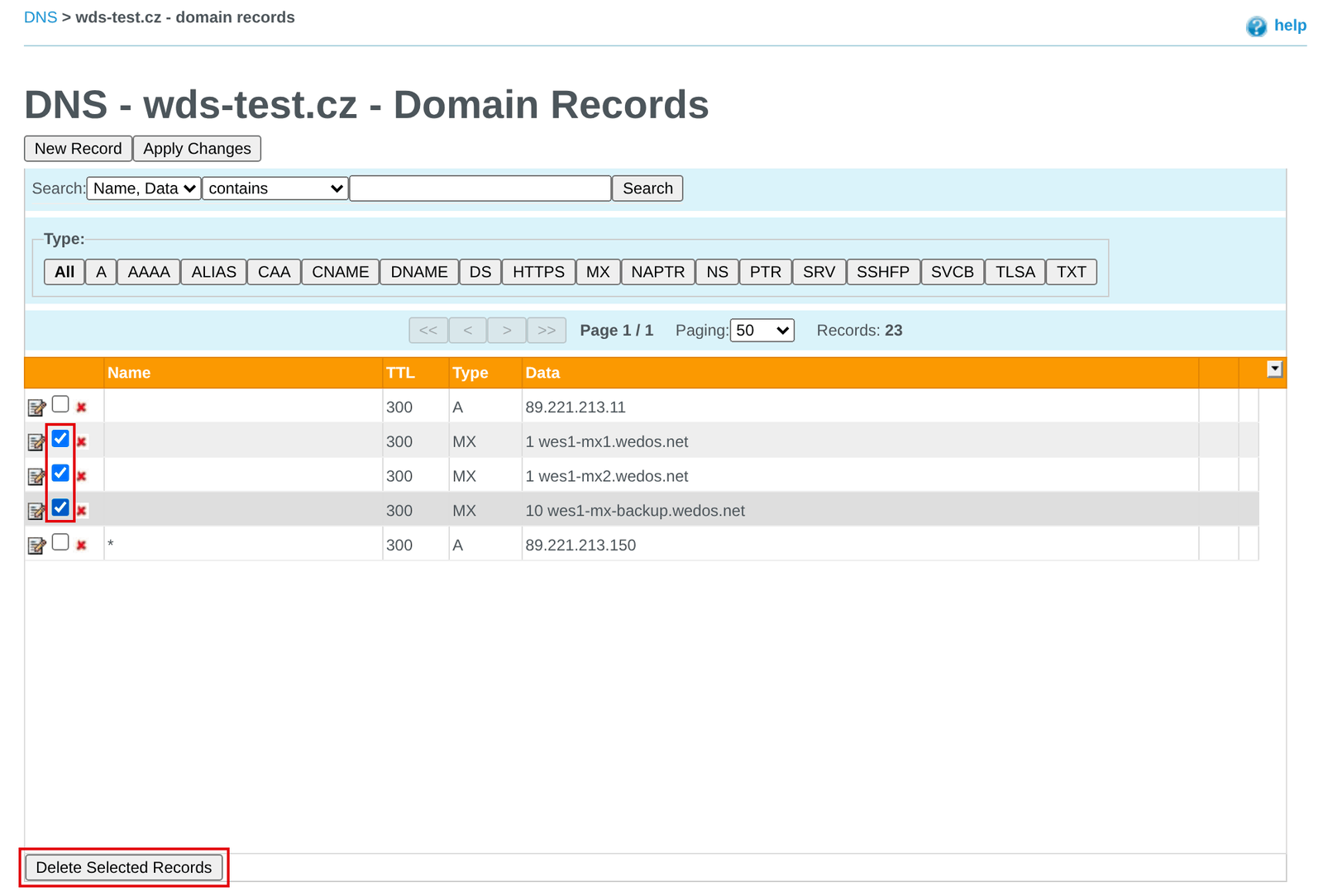
To delete several records at once, follow these steps:
- Tick the checkboxes on the left side of the record list next to the records you want to delete.
- Click Delete Selected Records.
Common issues
The most common issues when working with DNS records include:
- An error message appears when creating or editing DNS records
- Record changes do not take effect
- The old website is still displayed
- Emails stopped arriving
- Can’t enter a record named @
- A record from another service does not work
Errors when creating or editing DNS records
Problem: An error message appears when creating or editing a record.
Cause: DNS records must meet certain conditions to work correctly. The system blocks records that violate these conditions.

Solution: Adjust the DNS records to resolve the error shown in the message. Common errors and their solutions include:
- Cannot insert a record with the same name and type if the TTL values do not match: Correct the TTL value so that it matches the records with the same name and type that you already have in the table. Most often it is 300, 1800 or 3600.
- Invalid A/AAAA record value. An IPv4/IPv6 address must be entered: Check that the data field contains only one address in the required format and nothing else.
- Invalid MX record value. It must be in the format numeric priority + space + domain name of the mail server: Check that the data field contains a number (if you don’t know which one, enter 1) followed by a space and MX server address of your provider. Enter the address without protocols (http, https), as in the example.
If you need to enter several MX servers, create a separate record for each of them. - Cannot insert a CNAME record with this name: Change the record name so that it contains either the * character or a valid subdomain name. The name of a CNAME record must not be empty.
- Cannot insert record with same name as an existing CNAME record, and vice versa: If you need to replace the current records of a subdomain with a CNAME record, delete all other records that contain this subdomain in their name (including higher-level subdomains). Then enter the CNAME record again.
If you need to add a record of another type to a name that has a CNAME record, delete the existing CNAME and point the domain another way, for example with A or AAAA records. - The maximum number of records for this domain is 50: If you need more than 50 records for a domain, ask support ⧉ to increase this limit. State the domain name and the reason for requesting an increase of the DNS record limit.
Record changes do not take effect
Problem: More than 60 minutes have passed since you changed the records, but the change has not taken effect.
Cause: The most common cause is that you use another provider’s DNS servers, or that you mistakenly entered a value containing the domain name in the name field (e.g. sub.domain.tldinstead of just sub).

Solution: Make sure you use DNS servers (NSSET) WEDOS and that they have not changed in the last 48 hours. Also check that the record name field does notcontain the domain name.
The old website is still displayed
Problem: After changing the A and CNAME records to a new webhosting provider, the old website is still displayed.
Cause: Most often, AAAA records, which also point the website, were not edited or deleted.
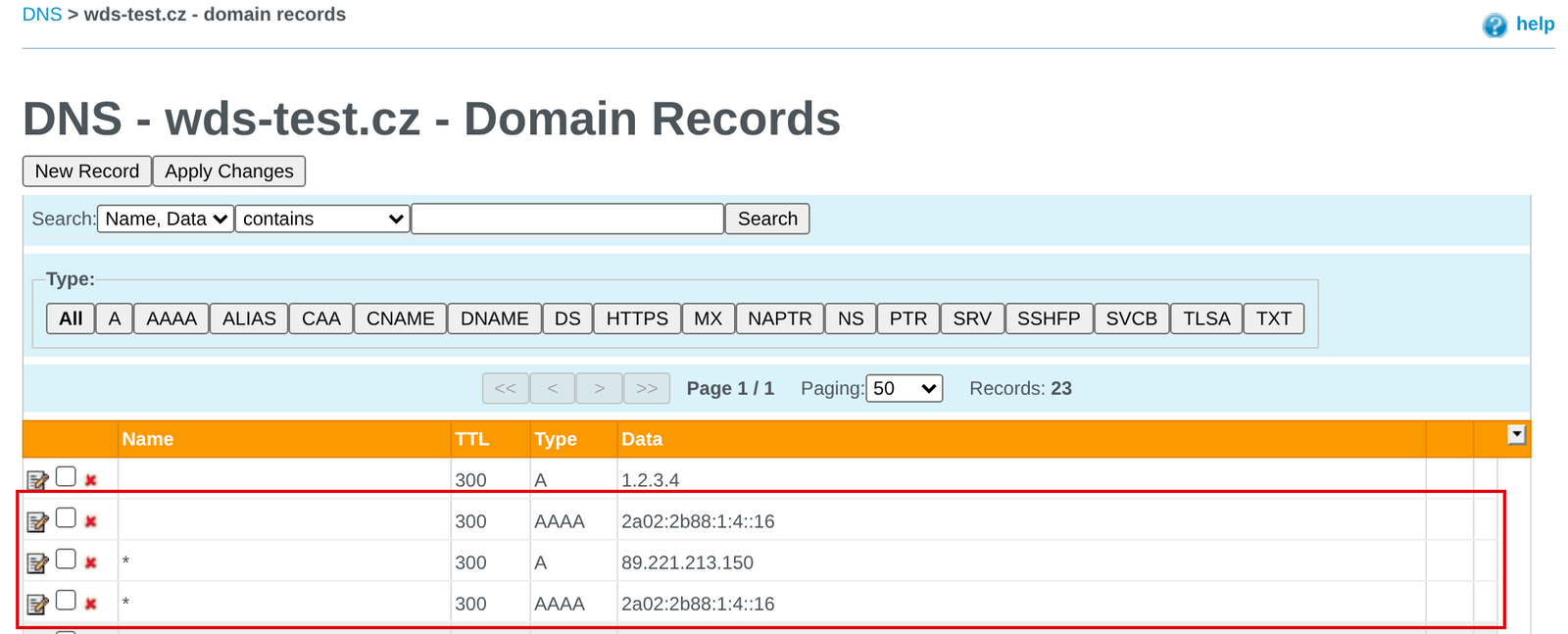
Solution: If the new provider does not support AAAA records, delete all of those that point the domain to the original web hosting. Also check that no old A records have been left among the DNS records.
Emails stopped arriving
Problem: After changing the MX records to a new provider, emails stopped arriving.
Cause: Most often, the record has a name entered by mistake (often, for example, mail). Less often, the domain has MX records of different providers and emails go to a different provider than the one you expect.
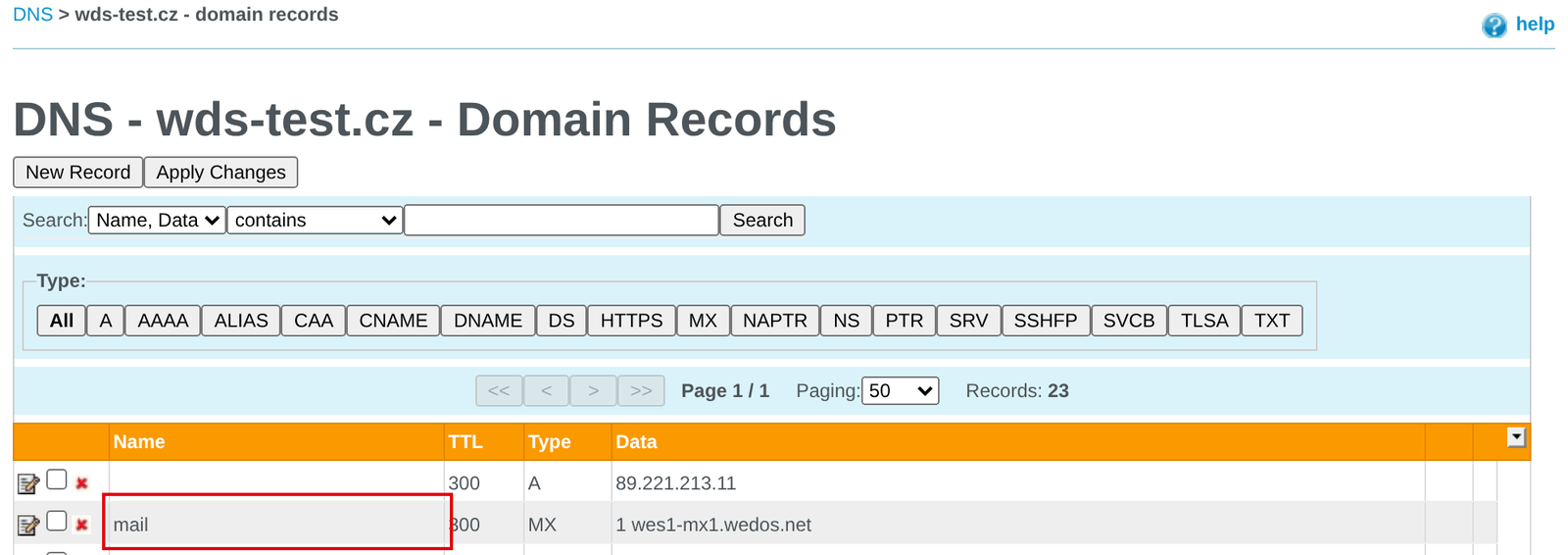
Solution: Create the records again with an empty name.
If the domain has MX records of several providers, delete all MX records except those of your current provider.
Can’t enter a record named @
Problem: The service requires a record (often of type CNAME) named @, but the administration does not accept it or reports “Cannot insert a CNAME record with this name”.
Cause: With us, the main domain is represented by an empty name; the @ character is not used. A CNAME record is only for subdomains and cannot be entered with an empty name.
Solution: For A, AAAA, MX or TXT records, leave the Name field empty. If you need to point to another name using an empty name, use an ALIAS record (see DNS – ALIAS and CNAME Records). However, the target service must accept ALIAS.
A record from another service does not work
Problem: You entered records from the provider of your e-shop, email or mailing service (e.g. DKIM with a name such as sek1._domainkey, domain verification, DMARC), but the service does not see them.
Cause: In the Name field, the full name including the domain was entered (sek1._domainkey.wds-test.cz), and the system appends the domain to it once more. Sometimes the quotation marks from the service’s guide also remained in the TXT record data.
Solution: In the Name field, enter only the part before the domain name, in the example sek1._domainkey. Remove the quotation marks from the TXT record data. Then click Apply Changes, and the record takes effect within 60 minutes. The setup of SPF, DKIM and DMARC is described in the article Email – SPF, DKIM and DMARC.
Frequently asked questions
The service’s guide asks for a DNS record named @. How do I enter it?
Leave the Name field empty. Do not add the @ character or the name of the main domain. A CNAME record with an empty name cannot be entered, see Can’t enter a record named @.
How do I point the eshop subdomain somewhere other than the rest of the website?
Follow the guide DNS – Subdomains.
I switched to a Webhosting without an IPv6 address. Can I delete the old AAAA records?
Yes, definitely delete the old AAAA records. Some services prefer them over A records and would then point the domain to hosting that no longer exists.
How long does it take for a changed DNS record to take effect?
Within 60 minutes after clicking Apply Changes (without clicking, changes are applied after 5 minutes), provided you use our DNS servers and do not have an especially long TTL set. If you do not use our DNS servers, changing the record with us has no effect on the internet.
The provider sent me the record name sek1._domainkey.wds-test.cz. What do I enter in the Name field?
Just sek1._domainkey. In the Name field, always enter only the subdomain without the domain name, otherwise the system appends the domain once more.
The provider sent me a TXT record (e.g. a DKIM key) longer than 255 characters. Do I have to split it into parts?
No. Paste the entire value into the Data field in one piece, without quotation marks. The system splits it into parts of at most 255 characters in the zone itself, and you will then see them one after another in quotation marks in the current DNS state.
What TTL can I set for a DNS record?
From 300 to 172 800 seconds, i.e. from 5 minutes to 2 days. The system does not accept a record with a different TTL; via WAPI you will get an error with code 2317.
Can I enter a record named *.cdn or cdn*?
The name *.cdn is allowed and applies to all subdomains of cdn.wds-test.cz that do not have their own record. The name cdn* or any other with an asterisk in the middle or on the right cannot be entered, and an NS record with an asterisk is not supported.
Can you set up the DNS records for me?
Yes, this is a paid service according to the price list. Send the request, authorized, via the contact form ⧉ and attach the instructions from the service provider. The setup itself is described in the chapter Managing DNS records.