
This guide covers switching from one VEDOS hosting type to another (e.g. Webhosting to Mailhosting). If you need to change the service plan, follow the guide Services – Changing the Plan and Billing Period.
In this guide you will learn:
- General procedure for changing the hosting type
- How to cancel the original hosting and release the domain for the new one
- How to move your website
- How to move your email
- Troubleshooting common problems
- Frequently Asked Questions
Changing the hosting type
Changing the hosting type does not automatically move data between services. It only releases the service name for another hosting type.
You usually change the hosting type when optimizing for the needs of your website and email services. The most common changes include:
- Mailhosting to Webhosting or Hosting WP. If you have email with VEDOS and now also want to run your own website, switch to Webhosting or Hosting WP, which include email themselves. The exceptions are the LowCost WP and Website SODEW web hostings, which do not include email services.
- Webhosting to Mailhosting. If you run your website with another provider and only have email with VEDOS, you can save significantly by changing the hosting type to Mailhosting.
When making the change, you usually follow these steps:
- Preparing the new website on a subdomain (optional step): Especially when moving to a completely new website, we recommend preparing and testing everything on a subdomain first, for example
newwebsite.yourdomain.tld. Hostings created with a subdomain name do not conflict with services that share the same main domain. At the same time, you have a development and testing environment at hand without affecting the original website on the main domain. - Releasing the domain of the original hosting: Once you are ready to switch from one service to another, you need to release the domain of the original hosting. Only then can you order a new service for this domain, or rename your test service to it.
- Moving the website or email: If you did not move the existing content in the preparation step, do so after the service has been set up.
Releasing the domain of the original hosting
VEDOS hosting services tied to a specific domain or subdomain are mutually incompatible. If you want to set up hosting for a domain that another hosting already uses as its name or as an alias, you must first change or completely remove that name. You can do this in the following ways:
- By cancelling the hosting service (letting it expire)
- By renaming the hosting
- By removing a Webhosting alias
Cancelling the hosting
Cancelling the hosting is the simplest way to release the domain of the original hosting.
By submitting a cancellation, you set the service to expire. The service expiration date does not change; the system simply stops trying to renew it. The time you have to move your data and email is therefore determined by the expiration date of this service.
Follow these steps:
- Log in to the Customer Administration ⧉.
- In the navigation bar, select the type of service you want to cancel.
- Select the specific service from the list.
- In the left menu, click Service cancellation/expiry.
- Select Cancellation type.
- Tick the checkbox release the domain for another service.
- If you want to move existing email to the new service, also tick the option keep email services functional for migration to another service.
- Enter the reason for termination.
- Click the button Submit Cancellation.
Cancel/expire the service:

Renaming the hosting
Releasing a domain name by renaming is useful when you do not want to cancel the service outright, because you have another use for it or need more time to move your website and email to the new service.
If you rename the service mydomain.tld for example to oldwebsite.mydomain.tld, you can set up a new service for the original name, or rename another service to it (for example a service on a test subdomain). Follow the renaming guides for:
Removing a Webhosting alias
A Webhosting service can have several domain names, which you set up using so-called aliases. You can find more information and the procedure for removing aliases in the guide Webhosting – Aliases.
Moving the website
To move the original website to the new service, follow the instructions for the target service:
- Webhosting: Webhosting currently does not support any automated moves from other VEDOS services. For a move from Hosting WP you can use any migration plugin; the pages (but not the editing interface) from WebSite 1.0 can be moved to Webhosting by customer support on request.
- Hosting WP: Hosting WP supports moving from WordPress on Webhosting using the VEDOS migration plugin. You can find more information in the guide Hosting WP – Migrating from Another Service.
Moving email
When switching between hosting services with a domain name (Webhosting, Mailhosting, …), you can leave the email on the mail server under the original domain. If you then set up a service supporting email for this domain, the system pairs them automatically.
If, instead of setting up a new service, you want to add the domain as an alias of an existing Webhosting, avoid keeping the email on the original domain. A domain blocked on the mail server prevents the alias from being added. Migrate the services manually following the chapter Additional email migration.
The short procedure for changing the hosting with an email move is:
- Cancel the original service following the guide in the chapter Cancelling the hosting and tick the checkboxes release the domain for another service and keep email services functional for migration to another service.
- Before the original service expires, order a service of the new type with the original domain in the same customer account.
Keeping existing email
If you tick the option when cancelling the original service option keep email services functional for migration to another service, the system makes the following changes:
- It releases the domain name of the original hosting service but keeps the domain on the mail server. The email of a service cancelled this way therefore keeps working until the service expires.
- If a new hosting service with the same domain name is created in the same customer account before the original service expires, the system automatically sets up the following for it:
- A plan or add-on services so that it has the same email space as the original service.
- A link to the original email services, if they are still active.

If you order the new service before the original service expires, email will work without any interruption or need to move it.
Additional email migration
All VEDOS services that support email include automatic mailbox migration. You will use it mainly if, for some reason (for example because of a move to an alias), you did not use the automatic email move within VEDOS hosting services.
For a successful migration, prepare the following:
- IMAP server name: You can find it following the guide Email – SMTP, POP3, IMAP.
- Names and passwords of the source mailboxes: Enter mailboxes including the service domain. If you removed the service’s name or renamed it, write the current service name after the @ sign, for example
mailbox@old.domain.tld, ormailbox@w123456. If you removed a Webhosting alias, enter the mailbox name with the main domain of the Webhosting.
You perform the automatic migration itself in these steps:
- Log in to the Customer Administration ⧉.
- In the navigation bar, select the type of service you want to move the email to.
- Select the target service from the list.
- In the left menu, click Migration from competitors – email.
- Fill in the prepared IMAP server and the mailbox details.
- Confirm the notice about how migrated emails behave.
- Click the button Continue.
Open the interface for automatic email migration to the service:
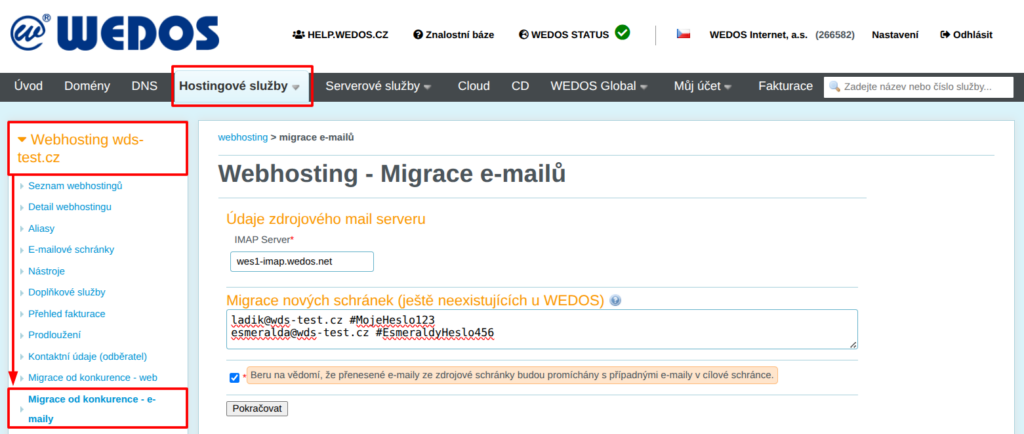
You can find the complete guide to email migration, including solutions to common problems, in the guide Email – Automatic Migration.
Common problems
Common errors when switching between Webhosting and WebSite services include:
- The order is blocked by another existing order with the same name
- The domain is in a different customer account
- The order for the new service is significantly more expensive
- An error or the old website is displayed
Existing order with the same name
Problem: An error message is displayed: An order (of a service) for this domain already exists in the system.

Cause: The system has an existing service or an active service order with the given domain name (alias).
Solution: Make sure that the removal of the name or alias of the original service was completed successfully. If the service still has its original name, try performing the action again from a different browser.
If an unpaid order is preventing the new service from being set up, ask Support ⧉ to cancel it.
Domain in a different customer account
Problem: An error is displayed: The domain is in a different customer account.

Cause: If you are setting up a service for a domain registered with VEDOS, the service and the domain must be in the same customer account, at least temporarily.
Solution: Move the domain to your own account, at least temporarily, using the authorization code or moving services using login and ID.
Increased price of the new order
Problem: The price of the new hosting order is higher than the price list indicates.
Cause: If, when cancelling the service, you request to keep existing email, the system creates the new order so that the resulting service has the same mailbox capacity. If you are switching from a NoLimit service with 10 GB for email to Mailhosting Individual or LowCost hosting (with a default capacity of 5 GB), the system requests an increase even if you have significantly less email or do not use it at all.
Solution: If you do not use email services, untick the request to keep existing email when cancelling the service, or cancel it before completing the order for the new service on the cancellation/expiry page using the button.

If you do use email services but want to set up the new service with a lower capacity, also cancel the transfer of email services, and once the new service is set up with the parameters you want, migrate the email following the chapter Additional email migration.
Non-working or old website
Problem: The old website or an error message is displayed.
Cause: Website content is often cached in the browser. The browser may then display data from the original website even though the domain already points to a different hosting.
Webhosting services have different DNS records of type A and AAAA. When renaming and creating services, you can let the DNS records be set automatically. If you decline the automatic change by unticking the relevant checkbox, you must point the domain to the service later.
Solution: If the original website is displayed, first try loading it without the browser cache using the keyboard shortcut Ctrl+Shift+R.
If an error is displayed, point the domain to the new service following the guide Domains – Pointing to Services, or manually following the guide DNS – Domain Records. Automatic DNS routing only works if the domain has its DNS records with us. Otherwise, you must set the DNS records manually following your provider’s instructions. Service addresses can be found in the table of the same name in the Service detail.
Frequently Asked Questions
There are still quite a few days left until the original service expires. How can we use this period?
If you have no use for the original service that you released by changing the type, you can request a transfer of the proportional part of the unused period to the new service. When cancelling such a service, state the name and type of the new service. If you need to end the service at a later date, for example to have enough time to move data and email, state this date in the text as well.
We let the service expire, but it has expired and we cannot finish moving the website or email. Can you turn it on again for a few days?
Customer support can temporarily enable a hosting service, but only up to 5 days after expiration. We cannot temporarily enable a service that expired 6 or more days ago.
When we remove the domain of the original service to release the name for the new one, how can we access the website and email on the original service?
You will not be able to access the website itself after the name is removed, but the files and data on FTP and in databases remain until the service is deleted. If you want to keep the old website available, for example on a subdomain, instead of cancelling the hosting, rename it.
Mailboxes are available under the domain corresponding to the service name. So if the service name after cancellation is, for example, w123456, you can access the mailbox mailbox with the login mailbox@w123456. This should work both for webmail ⧉and for any email client. However, no new email arrives in the mailboxes of a service whose name has been removed, so do not put off migrating and, above all, creating the new mailboxes (they are created automatically during migration, and email can be moved into them later).
The exception is when you ticked the option to keep email services functional when cancelling. In that case, email continues to work on the original domain.