
This guide covers website problems on the Webhosting service (including WMS).
- If you are having a problem with a domain or DNS, follow the guide Domains – Troubleshooting or DNS – Troubleshooting.
- If you are having trouble connecting via FTP, follow the guide FTP – Troubleshooting.
- If your emails are not working, follow the guide Email – Troubleshooting.
- If you use the WEDOS Protection service (find out using Webhosting diagnostics as described in this guide) and the website is not behaving correctly, read Protection – Website Troubleshooting ⧉.
This article covers:
Diagnosing Website Problems
Většina běžných chyb je dobře popsaná a k použitelnému návodu na jejich řešení se nejlépe dostanete zadáním chybové hlášky nebo stručného popisu chyby v kombinaci s názvem poskytovatele (případně redakčního systému) do vyhledavače (Google, …), například Error 500 Prestashop WEDOS.

If you can’t find a solution, try the following steps:
- Run the domain diagnostics as described in the guide Domains – Diagnostics. There you can see whether the services are active or disabled, and whether they are run by VEDOS at all.
- Check the Status service at wedos.status.online ⧉. You will find the web server name in the diagnostic output from the previous step.
- Go through the chapter Troubleshooting Website Problems.

More advanced tools suitable for diagnosing website problems include:
- Logging. It allows you to locate specific errors (Errorlog) and, where relevant, their relation to the number of page visits (Accesslog). Once a month you can have Webhosting logging for 24 hours free of charge. You will find the guide in the article Webhosting – Logging.
- Browser developer tools. They are especially useful for examining non-working parts of pages (Network) and scripts (Console). You will find instructions in your browser’s manual.
Troubleshooting Website Problems
Website problems can arise in various places:
- With the domain or DNS: This typically includes domain expiry or another reason for the DNS servers being shut down, or alternatively a problematic change to the DNS records.
- In the Webhosting settings: Some service parameters may conflict with the application you run on the hosting.
- In the directory structure or files: These problems occur mainly after a problematic intervention via FTP, and more rarely when content is uploaded by other means.
- In the content management system or application: These problems are very diverse – any application, template, plugin or combination of them can cause an error. WEDOS provides guides (and support, where applicable) only for the most common of these problems.
- As a result of an attack: If your website contains malware, or an attacker has deleted or altered your data, we can provide a backup if the problem is detected in time. We do not handle the malware cleanup of the website itself, so seek help from a specialist.
Domain and DNS
The domain, DNS and Webhosting are separate services. Before troubleshooting, always make sure you know who the current provider of each of these services is.
K chybám domény a DNS dochází skoro výhradně vlivem změn těchto služeb, ať už manuálním (přepsání údajů o DNS serverech nebo záznamech), nebo automatickým (odstavení doménu registrem, automatické nastavení v administraci).
The most common problems with a domain or DNS include:
- Inactive domain has either expired or has not been set up yet. If you can, pay for the service; it should work again within 6–48 hours after the payment is successfully received in our system. If you cannot see a previously active domain in the administration, it is either in another customer account (or with another registrar), or the system deleted it after a certain period following expiry. You can find more information in the article Domains – Troubleshooting.
- Incorrect DNS servers. If you have recently changed the DNS servers (NSSET) of the domain, check that you have the correct A or AAAA recordsset up with the new provider. Also allow for a longer propagation time of the DNS servers, which usually takes 6–48 hours.
- Incorrect or missing A or AAAA records. For a website to work on a domain, it must have at least one DNS record of type A or AAAA. If your web hosting provider does not support a given record type (IPv4 or IPv6 address), make sure you have deleted the old records of that type so that visitors are not directed to the old address. You can find more information in the article DNS – Troubleshooting.
Some actions, such as setting up a new hosting, renaming, adding an alias, or activating WEDOS Protection ⧉, can automatically change the DNS records of type A and AAAA. When performing these actions, pay close attention to the automatic DNS setup options.
Webhosting Settings
Webhosting configuration errors most often appear after changing its parameters or updating the application running on the hosting.
The most common problems with Webhosting settings include:
- A disabled or restricted web server is easy to recognise – by the error screen with the message Webhosting is disabled. The web server is most often disabled after Webhosting expiry.

A Webhosting that has been expired for more than 30 days (7 days for a terminated Webhosting) is completely deleted from the system. You can restore it by ordering a new service and uploading your own backup. We cannot restore a backup of a deleted hosting on our side.
- Low performance most often shows up as Error 503 – Service Temporarily Unavailable, in which the allocated performance is exhausted and the server cannot keep up with further application requests.
- A problem with the PHP version or parameters is usually indicated directly by error messages, or you will run into it when troubleshooting application and plugin errors with their support. Some PHP parameters also depend on the Webhosting plan ⧉, others, including the PHP version, you can set according to the guide Webhosting – PHP Configuration. You can check the availability of the PHP functions your application requires in the PHPinfo (8.0) ⧉.
- Non-working HTTPS usually displays an error message about an insecure connection, or the message Not Found on Accelerator. In both cases, manually check the HTTPS settings of the Webhosting and fix any errors. Repeat the next HTTPS test at least half an hour after the administration shows the certificate as active. If the problems persist, contact Support ⧉.

Directory Structure and Files
Directory structure and file errors are mostly caused by an unprofessional intervention via FTP, or by a compromised website.
The most common directory structure and file errors include:
- Error 403 – Forbidden, where access to a directory is blocked, or to displaying the index.html or index.php file.
- Error 404 – Not Found, meaning the file was not found, mostly because it has been renamed or deleted.
- Error 500 – Internal Server Error, which is mostly caused by invalid directives in the .htaccess file, or by a conflict with subdomains on the webhosting.
- Broken directory structure by uploading the website anywhere other than the www folder (usually into the root directory) or the directories for alias domains and subdomains. Websites located in the subdirectories domains and subdom also require the use of the default .htaccess. Less obvious directory structure errors include problems with uploading files and storing tokens. Both are caused by a missing folder (tmp or session) in the root directory. In all of these cases, restore the basic directory structure of the webhosting as described in the guide Webhosting – FTP Reset.
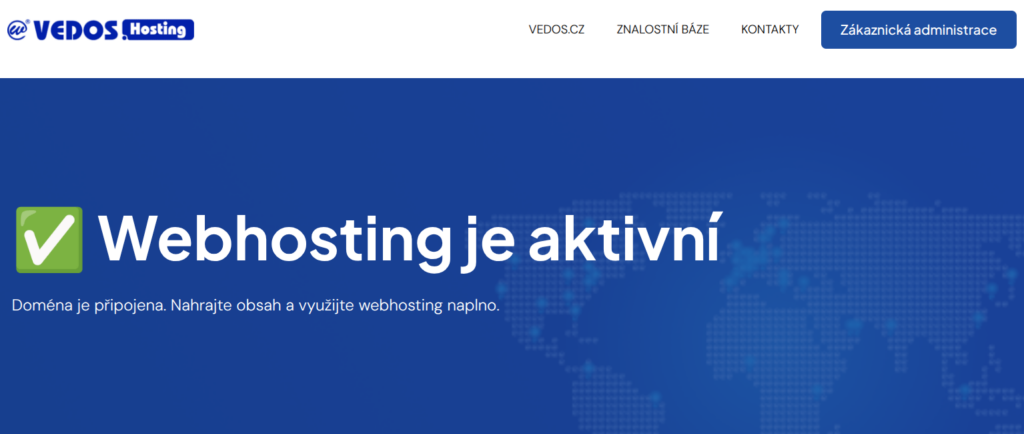
- Webhosting is active – this page is displayed by the original file index.html located in the folder www. Běžnými důvody, kvůli kterým se zobrazuje tato stránka místo běžného obsahu webu jsou:
- A conflict with the file index.php. If you have both files in one folder, the server runs the one with the extension html.
- A change to the file .htaccess. If the routing configured in the directory structure stops working after the website is compromised or the settings are handled incorrectly (e.g. restoring the default .htaccess), this default page may be displayed.
Content Management Systems and Applications
VEDOS is not responsible in any way for errors in content management systems or applications running on the webhosting, including applications installed by our installer, or migrated using the automatic migration tool.
If you request help from VEDOS Support, set up temporary FTP access for at least 1-2 business days, and keep in mind that such an intervention may take several days or may be rejected.
You can find solutions to the problems the community encounters most often in the directory of community Help guides ⧉. If you do not see a solution to your problem there, you can try to ask a question on the forum ⧉.
If you know which part of the system or application is causing the problem (for example, you can see the name of the faulty template or plugin in the file path), contact their support directly.
Compromised Website
A website compromise can manifest itself in various ways. The most common include:
- Changing or deleting website content
- Unwanted redirects
- Sending spam
On our side, we deal with a compromised website at most by limiting the website’s performance or shutting it down, and in the case of spamming by blocking the mail() function. If a clean backup of files and databasesis not available, you must resolve the matter on your own or through an external specialist.
Frequently Asked Questions
Why don’t I see any of the changes I made on my website?
If error messages or old content remain on the website even after fixes have been made, clear the cache of:
- The browser using the keyboard shortcut Ctrl+Shift+R, or according to the guide for your particular browser.
- The WEDOS.protection system, if your website uses it (find out using Webhosting diagnostics as described in this guide).
What should I do if none of this solved my problem?
Activate temporary FTP access for Support and write to us via the contact form ⧉. Provide the website name and a detailed description of the problem, including screenshots ⧉ of error messages or unwanted behaviour. If the resolution takes a longer time, be patient and keep the temporary FTP access active. If you decide to solve the problem by your own means during this time, end the FTP access and let us know.
How long does it take VEDOS Support to solve my problem?
We usually send guides for solving known problems within 1 hour. If the intervention of the CMS/WebSite department or a technician is required, the resolution may take several days – it always depends on the difficulty of the solution and the workload of the department in question.